
I want to install a washer/dryer combo in my co-op apartment. What do I need to know about the approval process, what kind of laundry machines should I get, and how much will they cost?
A washer/dryer of your very own is on most co-op owners' wish lists. Carrying loads of laundry up and down from your building's basement—or back and forth to the local laundromat—can get tiresome quickly. However, if you're thinking of forking over cash for a laundry combo unit and installing it in your apartment, there are a few considerations to keep in mind.
Before allocating closet space to house your new appliances, you'll need to obtain permission from your board or building management. That's because some older plumbing systems aren't equipped to handle the workload of washing machines in every apartment. Additionally, there are "wet-over-dry" rules to be aware of, as well as permitting and safety considerations.
Assuming you can get board approval—itself a tall order—you'll need to choose the correct location and appliances for your situation and stay on the right side of New York City's building codes.
The following expert guidance will help you figure out your options.
Editor's Note
[Editor's note: An earlier version of this post was published in November 2024. We are presenting it with updated information for November 2025.
Check with your board or building
Many NYC buildings, whether rentals, co-ops, or condos, do not allow in-unit washer/dryers—period. Some co-ops and condos will only allow them on a case-by-case basis, while others have established blanket policies. You should always obtain approval from your board or building management for the addition; otherwise, the consequences can range from having the machines removed to incurring thousands of dollars in fines if a fire or flood in a neighbor's unit is linked to the installation.
Loading ad...
In older buildings, the waste pipes can be either too small or packed with sediment, or the building or specific apartment line may have existing drainage issues. So adding suds can cause backups that affect nearby apartments.
Furthermore, if your washing machine malfunctions or overflows, it can cause damage to the floors below. This is why many buildings require a containment pan under the washing machine, along with an overflow sensor in the pan and an automatic shut-off valve.
According to architect Jorge Fontan, founder of Fontan Architecture, some buildings may require the addition of a waterproof membrane underneath the finished floor that extends at least six inches up the walls. He also recommended including soundproofing underlayments when installing new floors; if not, you can install the machines on sound-isolating pads to help absorb vibrations.
Dryers can present their own hazards, as discussed below. Should you get the coveted go-ahead, you'll still need to be mindful of Department of Building compliance (also covered below).
Beware of wet-over-dry restrictions
Once you've determined that your building allows in-unit washer/dryers, you'll need to comply with its specific rules.
"Ask your managing agent or board if self-managed for a copy of the alteration agreement and any guidelines for the installation," said Michael Wolfe, president of Wolfe Realty Services, which specializes in board advisory and management.
Loading ad...
Most likely, the machines will need to be located in or near a "wet space," typically a kitchen or bathroom, to be close to the waste and supply pipes (also known as the "stack").
An adjacent closet is a common option, though you may not want to give up that precious storage space.
If you do have a closet in mind, be sure the installation there doesn't flout wet-over-dry rules, where any potential leaks could cause damage to "dry" spaces like a bedroom or living room in the apartment below. If all the units in your line share the same layout, this will be easy to predict—but not if you or your downstairs neighbors have made alterations. Always seek guidance from the board or property manager on this matter.
Wolfe reported that some buildings have relaxed this aspect of the wet-over-dry rules as long as safeguards are part of any installation. Specifically, he pointed to the use of modern waterproofing systems, including full-pan waterproof membranes (such as by Schluter or Laticrete), leak detection sensors or shut-off valves, or proper pitch and secondary drains.
Stacked vs. side-by-side units
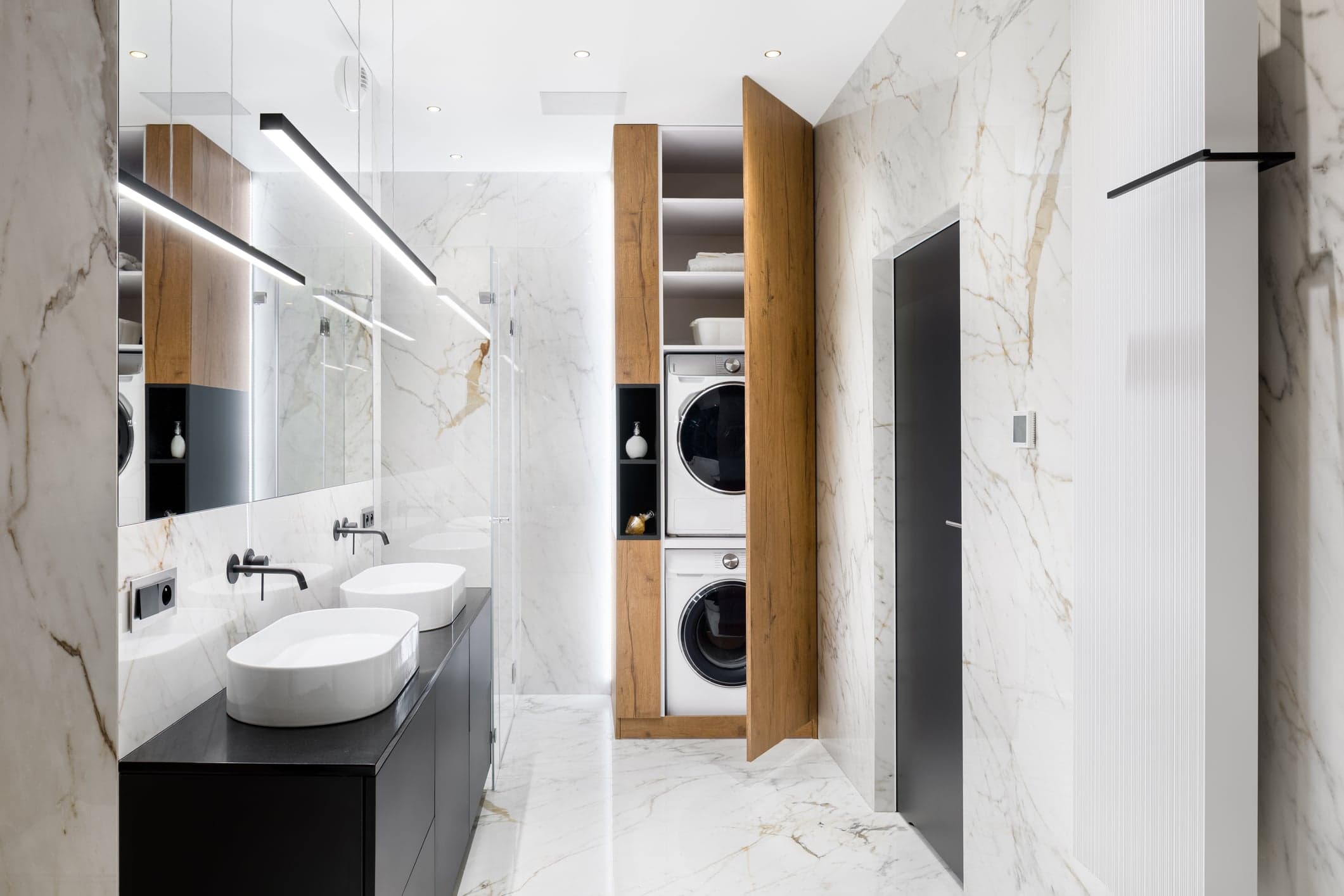
Often, the most logical place for these appliances is in a second, full bath—such as by replacing a tub with a shower stall and a stacked washer/dryer. Another option is to convert an entire half-bath into a laundry station.
Some owners install washer/dryers in the kitchen, close to plumbing and gas lines. On the downside, space can be a little tighter, and the height of many units is taller than a typical counter height.
Loading ad...
An all-in-one washer/dryer is another space-saving option, though consumer reviews (and our own in-house experience) suggest that the dryer can take as much as three times longer than a regular dryer, meaning you'll need to do smaller loads at a time—and forget about washing large items like comforters.
Be sure to comply with the DOB
When installing a new washing machine, the city's Department of Buildings requires a master plumber to obtain a permit and do the work. Depending on the scope—for example, if you're altering a closet or the electrical or plumbing lines—you may need to get additional permits.
Gas machines have a whole other set of issues: You'll need to tap into an existing legal gas line and provide adequate ventilation, which is why these models are typically put in a windowed bathroom or kitchen.
The DOB also allows gas appliances to be installed in closets, provided the code requirements for ventilation are met (for example, by connecting to the building's mechanical system). The closet must also have a sprinkler head in buildings where a full sprinkler system is required. These same rules apply to an electric dryer, too.
According to Wolfe, under the NYC All-Electric Building Law (Local Laws 154 and 139 of 2021), any building filed after 2027 (for large buildings) is prohibited from using gas appliances, including dryers.
However, gas dryers are still permitted in existing buildings—and are often the only option due to limited electrical availability in pre-war co-ops, though management may restrict new gas lines or replacements that require re-piping or venting modifications, Wolfe noted.
Loading ad...
You'll need a final DOB inspection for all gas and electric work to ensure it has been done properly.
- Many buildings—rentals, co-ops, and condos—do not allow them at all in individual units.
- Those that do typically require them to be in a "wet" space, such as the kitchen or a bathroom.
- You may also need a containment pan with an overflow sensor and automatic shut-off valve.
- Often, the most logical place for these appliances is in a second, full bath (replacing a tub).
- The kitchen is another option, though the height of many machines is taller than counter height.
- All-in-one models save on space but work best with smaller loads, as drying takes much longer.
- Be prepared to spend around $1,500 to over $3,000 for a stackable, apartment-size combo.
- Then there's the cost of running new plumbing and electricity to the space (such as a closet).
- Buy the best quality for your budget—the average lifespan for a washer/dryer is over 10 years.
Going with gas or electric dryers
Appliances with Energy Star ratings are the most efficient. According to the Energy Star guidance, gas dryers may cost less to operate but typically have a slightly higher initial price tag, while electric dryers may be slightly cheaper to purchase initially, but can be more expensive to run.
Like most electric dryers, gas models require venting to the outside; they also necessitate a dedicated gas line, which may not always be practical and could increase the installation cost.
Wolfe pointed to vented or ventless heat-pump dryers as the default choice for approval, especially for shareholder renovations. "Heat-pump dryers are efficient, compact, and those that don't require exterior venting are ideal for older buildings trying to comply with Local Law 97 and DOB codes," he said.
Loading ad...
That said, most standard-size electric units require a 240-volt outlet, which can be challenging to accommodate in older buildings. In these cases, the more compact dryers on the market need only a 120-volt wall outlet.
Either way, you'll need to address lint buildup (more on this below). You may also need to give ventless appliances regular wipe-downs—and once every few years, you might have to disassemble the unit and clean the inner workings thoroughly.
The pros and cons of high-efficiency machines
High-efficiency washing machines—designated by 'HE' on the label—generally use less water and require specific detergents that produce fewer suds, making them easier on plumbing systems and the environment. Indeed, they are the only models allowed by certain buildings.
Beware of a couple of potential downsides: Some owners complain of mildew problems after prolonged use. It's best to keep the washer door slightly ajar between uses to allow the interior to dry out. The wash cycle is also longer than usual, trying the patience of many users. On the plus side, the drying time will be shorter, thanks to the extra water extraction capabilities of these machines.
Why the lint filter needs to be cleaned diligently
Lint buildup can be hazardous—you're combining heat and a flammable substance in tight proximity. It's essential to clean the lint filter after every use, as typically specified in the appliance's owner's manual.
You may also want to have a professional inspect the exhaust areas and remove lint buildup annually or every other year. A dryer inspection typically costs less than $100; cleaning can add an additional $200. It's a small investment that can avoid a much larger cost in the future, and a critical step in protecting yourself and your neighbors.
Loading ad...
If your appliance vents to the outside, be especially cautious about longer ducts with "elbows," where lint can harden or even become wet due to condensation. One solution is to add a booster fan at the midpoint or an exhaust fan at the end during installation. You can also have a thin section of the duct cut out and a second, removable lint trap added to catch build-up. Hire a professional to advise you on what's warranted.
And consider buying a machine that's equipped to shut down in the event of a fire—many newer models have this safety feature.
How much to budget for
The price for adding a stackable washer/dryer to a closet space could stretch to around $7,000. That includes the cost of running new plumbing and electrical lines to the space. However, there may be circumstances where you can cut some of that cost if you're able to take advantage of existing lines, such as in a bathroom or kitchen.
Be prepared to spend between $1,600 and $3,000 for an apartment-size washer/dryer combo from manufacturers like GE or Frigidaire. (The recommended combo by at least one source is this GE model, listed at $2,999.)
Loading ad...
Maytag is a bit cheaper, with full-sized, front-loading, matched stackable units ranging from $749 to over $1,000, meaning you need to double that price for the set.
Electrolux stackable washers and dryers start at around $1,000 each; stacked combos range from $2,099 to $2,799.
As with other home appliances, it's always a good idea to purchase the highest quality models that fit your budget. Given the average lifespan for a washer/dryer is over 10 years, you'll be spreading that investment over the long haul.
—Earlier versions of this article contained reporting and writing by Tracey Kaler and Mimi O'Connor.